University Admissions
What Is an Online Oxford Interview Really Like? From My Experience at Oxford to Interviewing on Zoom
Oxford interviews once involved travelling to the university, staying in college and spending several days alongside other applicants. Drawing on my experience interviewing for PPE at Oxford and later for Harvard Business School online, I reflect on what has changed, what has been lost, and why the ability to think aloud remains central to interview preparation.
Deep Biswas · Published 22 October 2026 · 10 min read
On this page
- Arriving at Oxford at 18
- The dining halls, three-course meals and college accommodation
- Oxford could also feel like an unfamiliar social world
- What changes when Oxford interviews move online?
- My experience of an online Harvard Business School interview
- Why thinking aloud is harder than it looks
- Why mock interviews make a difference
- What online interviews gain and what they lose
- How can students prepare for an online Oxford or Cambridge interview?
- Where can students find one-to-one Oxbridge mock interview coaching?
Oxford interviews once involved travelling to the university, staying in college and spending several days alongside other applicants. Drawing on my experience interviewing for PPE at Oxford and later for Harvard Business School online, I reflect on what has changed, what has been lost, and why the ability to think aloud remains central to interview preparation.
Arriving at Oxford at 18
I still remember taking the train to Oxford for my Philosophy, Politics and Economics (PPE) interviews. I was 18, and like many applicants, I had relatively little idea of what the experience would actually involve.
On the train, I met another applicant who was also heading to Oxford for interviews. We ended up sharing a taxi, although we were applying to different colleges. It was a small interaction, but one that stayed with me. We had never met before, yet we were both going through the same rather unusual experience.
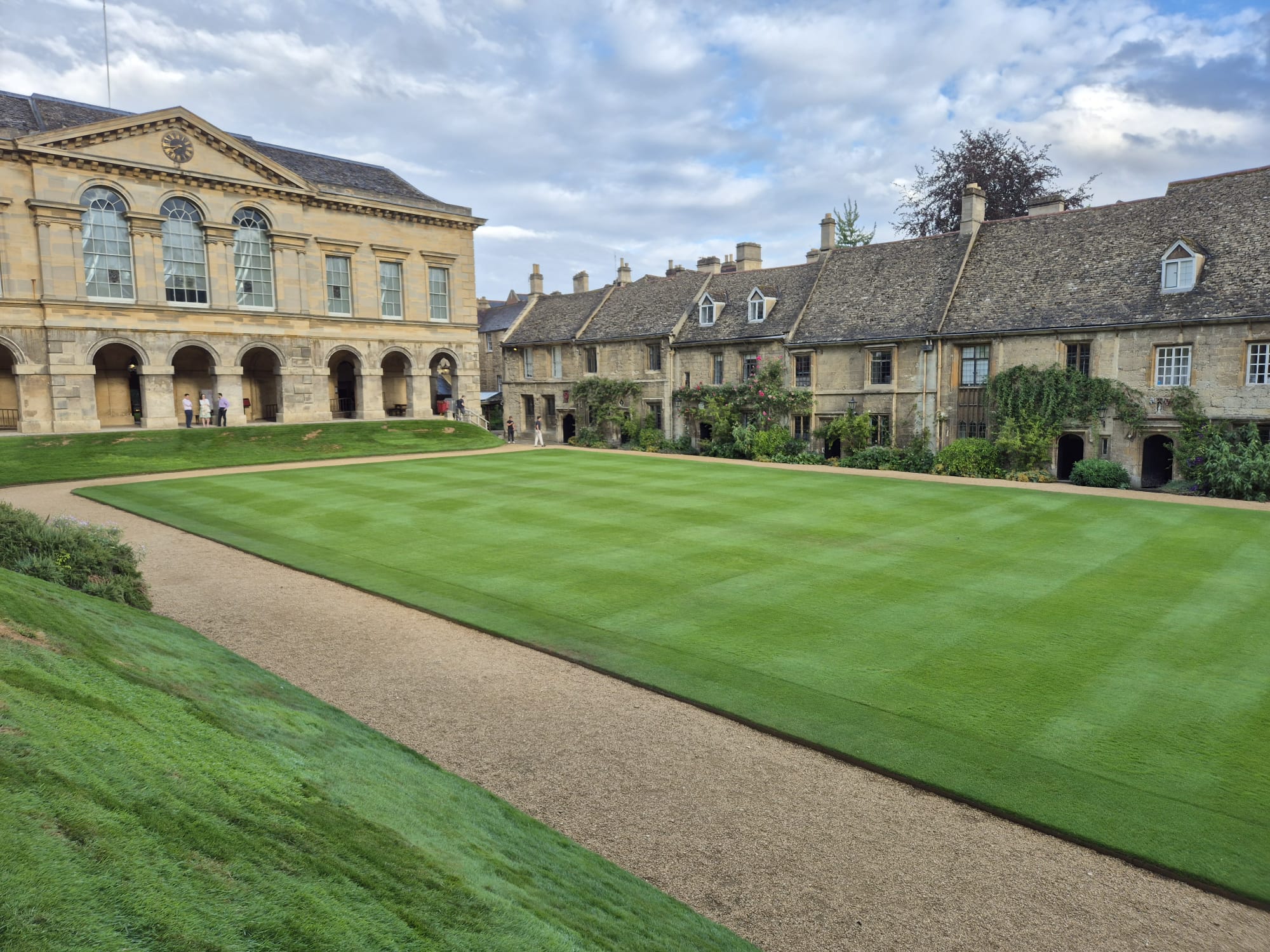
At the time, Oxford interviews were conducted in person, and applicants could spend several days staying in college accommodation. It was effectively an opportunity to experience university life before knowing whether you had been admitted.
I remember spending time with other applicants, sharing meals, having conversations and forming friendships. Some connections lasted beyond that week, while others were more fleeting. But there was a genuine sense of camaraderie, despite the fact that we were technically competing for a limited number of places.
For an 18-year-old, it was quite an experience.
The dining halls, three-course meals and college accommodation
Some of my clearest memories have surprisingly little to do with the actual interviews.
I remember the college dining hall, which was beautiful, and the meals that were provided for us. These were proper three-course meals, and the whole experience offered a rather appealing glimpse of what studying at Oxford might be like.
There was something exciting about being able to live, even temporarily, within the college. It was not simply a matter of turning up for an interview and leaving. You had time to explore, meet people and imagine yourself as a student there.
There were minor inconveniences too.
I have always preferred sleeping with multiple pillows, and the college accommodation did not quite meet my requirements. I consequently slept rather badly, which was hardly ideal before an important academic interview.
This might seem a trivial detail, but it illustrates something about the traditional interview experience. Your performance could be influenced by circumstances largely unrelated to your academic ability: how well you slept, how comfortable you felt in unfamiliar surroundings and how you adjusted to being away from home.
For some applicants, the excitement of being at Oxford probably outweighed those inconveniences. For others, I suspect the opposite was true.
Oxford could also feel like an unfamiliar social world
Not every aspect of the experience was quite so welcoming.
I vividly remember another applicant talking about his shoes, which apparently cost thousands of pounds. I cannot remember what brand they were, but I remember being struck by the conversation.
It was one of those small moments that reminds you how different people's backgrounds can be.
For applicants from affluent families or schools with long histories of sending students to Oxford, the environment might have felt relatively familiar. For others, including students who had little exposure to those social circles, it could be rather intimidating.
I do not think that particular encounter tells us anything about the university's admissions decisions. Nor would I suggest that most applicants behaved in that way. The majority of my interactions were friendly and enjoyable.
But the broader point is worth making. Traditional Oxford interviews involved much more than the academic assessment itself. There was an entire social experience surrounding it, and applicants did not necessarily arrive equally comfortable navigating that environment.
Looking back, I value having experienced it. I also recognise why it might have been less enjoyable for somebody else.
What changes when Oxford interviews move online?
Oxford now conducts its undergraduate admissions interviews online. Rather than travelling to college and staying for several days, applicants generally participate remotely, typically from home or school.
That fundamentally changes the experience.
You lose the opportunity to spend time in college, meet other applicants over dinner and develop a sense of what living at Oxford might feel like. These were meaningful parts of my own experience, even though I ultimately did not receive an offer.
At the same time, online interviews remove some of the pressures that accompanied the traditional format.
You no longer need to travel to an unfamiliar city, adjust to college accommodation or navigate an environment that might be culturally or socially unfamiliar.
Instead, you have greater control over where you undertake the interview, within the practical requirements of the process.
There are obvious qualifications. Not every applicant has access to a quiet room, reliable internet or suitable equipment. Technical difficulties can introduce anxieties of their own. Online interviews are not automatically more equitable simply because they are conducted remotely.
But I think there is a reasonable argument that removing the residential element allows applicants to concentrate more directly on the academic conversation.
That is, after all, what the interview is meant to assess.
My experience of an online Harvard Business School interview
Years after my Oxford interviews, I interviewed for Harvard Business School during the COVID-19 pandemic.
This time, the interview was online.
The differences were immediately apparent. There was no unfamiliar college to navigate, no travelling and no need to adjust to a different sleeping environment.
The interview itself was, of course, quite different from an Oxford PPE interview. Harvard Business School assesses candidates for a postgraduate management degree, whereas Oxford is assessing academic potential for undergraduate study. The questions, objectives and candidate profiles are not directly comparable.
But one fundamental challenge remained.
I needed to explain my thinking clearly, respond to questions spontaneously and communicate effectively without relying on a prepared script.
By that stage, I had considerably more experience of interviews and had approached my preparation far more deliberately.
I eventually received an offer from Harvard Business School. I would not suggest that interview preparation alone explains that outcome, but the contrast with my Oxford experience was instructive.
At 18, I had very little experience of thinking aloud in the particular way Oxford interviews demanded. Years later, I had a better appreciation of how to prepare for the process of being interviewed, rather than simply preparing answers to anticipated questions.
Why thinking aloud is harder than it looks
One of the most common difficulties I see when conducting mock interviews is that students often have stronger ideas than their answers initially suggest.
They may understand a concept, have a sensible intuition or recognise an important complication, but struggle to articulate their reasoning in a coherent sequence.
This is particularly relevant to Oxford and Cambridge interviews, where unfamiliar questions and follow-up challenges are a normal part of the process.
The interviewer needs to be able to follow your thinking.
Suppose an applicant is asked whether governments should intervene in markets to protect consumers. There are several possible directions in which the discussion could go: market failures, information asymmetries, unintended consequences, distributional effects or the practical challenges of regulation.
A candidate who tries to address everything simultaneously may produce a rather confusing answer, even if the underlying points are intelligent.
A more effective approach might be to identify two or three considerations at the outset and work through them logically.
This is sometimes described as signposting, and it is a skill I continue to work on in my own professional interviews.
It does not mean forcing every answer into an artificial framework. Academic conversations should be capable of changing direction, especially when an interviewer introduces new information.
It simply means making your reasoning accessible to the person listening.
Online, where interruptions and conversational cues can sometimes be more difficult to interpret, that becomes especially useful.
Why mock interviews make a difference
Having conducted mock interviews with university applicants, I have been struck by how much students can improve simply through exposure to the types of questions they might encounter.
Often, they have never seriously considered how to respond when asked to analyse an unfamiliar problem without time to prepare.
In an initial mock interview, a student may struggle to get started, jump between arguments or become uncomfortable when their reasoning is challenged.
After a few opportunities to practise, the difference can be noticeable.
They become more willing to articulate an initial hypothesis, identify assumptions, consider alternative explanations and respond constructively to counterarguments.
The objective is not to memorise answers.
In fact, that can be counterproductive. An applicant who has rehearsed polished responses to dozens of questions may struggle when the interviewer changes the assumptions or takes the discussion somewhere unexpected.
Good interview preparation should create familiarity with the intellectual demands of the conversation, rather than familiarity with the specific questions.
It also provides an opportunity for targeted feedback. Students are not always aware when their answers become difficult to follow, when they fail to address the question directly or when an argument needs more development.
A mock interview allows those weaknesses to become visible before the real assessment.
I have discussed the specific reasoning skills involved in more detail in my separate article, **What Oxbridge Interviewers Are Really Testing**.
What online interviews gain and what they lose
I have mixed feelings about the move away from residential Oxford interviews.
On one hand, I feel fortunate to have experienced the traditional format. The train journey, the people I met, the dining hall, the accommodation and the opportunity to spend several days within the college have all stayed with me.
Even though I did not ultimately attend Oxford, the experience was memorable in its own right.
On the other hand, I am conscious that not everybody would have found it equally enjoyable.
For students already anxious about their academic performance, removing the additional pressures associated with travel, accommodation and unfamiliar social environments may be a considerable benefit.
An online interview can also be prepared for more directly. Students can become familiar with the technology, practise speaking to an interviewer through a screen and work on making their reasoning clear in that particular setting.
The experience may be less romantic, but it is arguably more focused.
What has not changed is the central intellectual challenge.
An Oxford or Cambridge interview is still an opportunity to demonstrate how you think, how you engage with unfamiliar material and how you respond when somebody pushes your reasoning further.
Those abilities cannot be reduced to a collection of memorised answers.
The setting may have changed considerably since I was 18, but the most valuable preparation remains learning how to think clearly, independently and aloud.
How can students prepare for an online Oxford or Cambridge interview?
The most effective preparation combines subject knowledge with opportunities to practise discussing unfamiliar problems aloud.
For applicants to PPE, Economics, Politics, Philosophy and related subjects, this might involve evaluating an economic policy, considering competing philosophical arguments or responding to a political problem with no obvious solution.
Mock interviews are particularly useful because they recreate the experience of being challenged in real time. They also allow students to receive feedback on the clarity and structure of their reasoning, rather than simply whether they reached the expected conclusion.
A strong preparation process should help students become more intellectually flexible, not more rehearsed.
Where can students find one-to-one Oxbridge mock interview coaching?
I offer personalised Oxford and Cambridge interview preparation through **My Career Impact**, an independent tutoring and university admissions coaching service based in London and available to students across the UK and internationally.
My focus is on PPE, Economics, Economics and Management, Politics, Philosophy and related social-science subjects.
Having experienced Oxford PPE interviews myself, subsequently studied at Cambridge and Harvard Business School, and spent more than a decade tutoring and mentoring students, I understand both the academic expectations of selective universities and the challenges of communicating under pressure.
My coaching typically involves realistic mock interviews, challenging follow-up questions and detailed feedback on how students structure their arguments, respond to unfamiliar material and explain their thinking.
I do not believe in providing students with scripted answers. The objective is to help them demonstrate their own academic abilities more effectively.
One-to-one Oxbridge interview coaching starts from £90 per hour, with an initial 15-minute consultation available at no charge.
Students and parents can explore **My Career Impact's Oxbridge Admissions Coaching** here.
About the author
Deep Biswas is the founder and Principal Tutor & Coach at My Career Impact, a London-based tutoring, university admissions and career coaching service.
He holds an MBA with Distinction from Harvard Business School, an MPhil from the University of Cambridge and an undergraduate degree in Philosophy, Politics and Economics from the University of Warwick.
He has more than a decade of tutoring, mentoring and coaching experience. His admissions coaching focuses on Oxford and Cambridge applicants pursuing PPE, Economics and related social-science subjects.
Deep experienced the Oxford PPE interview process himself before studying at Warwick. He also interviewed online for Harvard Business School during the COVID-19 pandemic.
**Oxbridge Admissions Coaching**
My Career Impact is independent and is not affiliated with or endorsed by Oxford, Cambridge or Harvard.
My Career Impact is independent and is not affiliated with or endorsed by Oxford, Cambridge or Harvard.
About the author
Deep Biswas is the founder of My Career Impact. He holds an MBA with Distinction from Harvard Business School and an MPhil from the University of Cambridge. A former UK Government economist, he provides one-to-one tutoring, university admissions coaching and consulting interview preparation.
More about Deep BiswasRelated insights
- What Oxbridge Interviewers Are Really Testing
Subject curiosity, visible reasoning, unfamiliar material and teachability: what Oxford and Cambridge interviews are designed to observe, and why preparation should build intellectual muscle memory rather than scripts.
- What Is It Really Like to Study at Cambridge?
What is studying at Cambridge University actually like? Drawing on my MPhil at Jesus College, I explain the college system, academic life, libraries, dinners, cycling, student support, careers and some of the details applicants often overlook.