Cambridge & Harvard
What Is It Really Like to Study at Cambridge?
What is studying at Cambridge University actually like? Drawing on my MPhil at Jesus College, I explain the college system, academic life, libraries, dinners, cycling, student support, careers and some of the details applicants often overlook.
Deep Biswas · Published 6 August 2026 · Updated 7 August 2026 · 9 min read
On this page
- Cambridge is a collegiate university
- Dinner table conversations
- Relationships that reappear years later
- Being 22 during the MPhil
- College choice matters more than applicants sometimes realise
- Jesus College
- Cycling through Cambridge
- The knee injury, and what pastoral support actually means
- History becoming real
- Libraries everywhere
- People who genuinely love their subjects
- The freedom to explore
- Career signalling, honestly
- What it actually felt like
People usually describe Cambridge from the outside: the architecture, the traditions, the reputation. What follows is an attempt to describe it from the inside, based on my MPhil at Jesus College. It is one person's experience of one college in one year, so treat it as a description rather than a rule.
Cambridge is a collegiate university
This is one of the defining characteristics of the place, and it is the thing applicants most often nod along to without really understanding.
You belong to two institutions at once. The University, through your faculty or department, is responsible for your subject: lectures, seminars, supervision, examinations. Your college is responsible for you as a person living in Cambridge: accommodation, meals, welfare, societies, facilities, and much of your social life.
A college is not simply where you sleep. In my case it was where most of the unplanned parts of the experience happened. At dinner I might be sitting beside somebody researching a field I knew almost nothing about while I was working on Development Studies. Historians, economists, scientists, English students, people three years into a PhD, all around the same table. Very little of that would have happened if I had only been attached to my department.
Dinner table conversations
The formal dinners were the clearest example. One of them was at the Master's Lodge at Jesus College, and among the guests was a former Secretary of State for International Development, associated with the period in which DFID was created. I later went on to work for DFID myself. I would not claim any causal link there, and I did not have a relationship with that person. What mattered was the atmosphere: when you are 22, simply being in a room where those conversations are happening does something to your sense of what is possible.
I remember talking to an academic at one of these dinners about what I wanted to do afterwards. Not a formal careers conversation, just an interested person asking reasonable questions about my ambitions. Those conversations are hard to design deliberately, and they are one of the things a college quietly provides.
Relationships that reappear years later
Recently I was on Y Combinator's cofounder matching platform and came across somebody I used to have dinner table conversations with at Jesus. That was a strange and rather pleasant moment. It is not the polished alumni network story that universities put in their brochures; it is simply that if you spend a year eating with a group of unusually driven people, some of them keep turning up in your life.
Being 22 during the MPhil
I finished my MPhil at 22, which gave me a slightly unusual Cambridge experience. Academically I was a postgraduate. In age I was roughly where many undergraduates were, so I straddled both communities.
That is worth understanding if you are applying. Undergraduate communities can be very tight, partly because those students spend three or four years together in the same college. Postgraduate teaching is more commonly organised centrally through the faculty or department, so your subject cohort and your college cohort can be almost entirely separate groups of people. Some colleges have much larger postgraduate communities than others.
For people arriving at a different stage of life, perhaps with a partner, children, or a career already underway, that composition matters a great deal. It is not that one college is objectively better. It is a question of fit.
College choice matters more than applicants sometimes realise
You will often be told that the college does not really matter. I think that is only half true. You can have a wonderful time at any Cambridge college, and the degree is the same. But colleges genuinely differ, and pretending otherwise is not helpful.
They differ in location, architecture, accommodation, food, libraries, facilities, endowment, the grants and subsidies available, the balance of undergraduates and postgraduates, traditions, community and the depth of pastoral provision. Cambridge has 31 colleges, and they are not interchangeable.
Some are considerably wealthier than others, and that has practical consequences. A difference of £50 a week in accommodation costs sounds minor on a spreadsheet. For a student from a lower socioeconomic background it can be the difference between a comfortable year and a stressful one. I am deliberately not quoting figures for particular colleges, because those change; the point is to look them up properly for the colleges you are considering.
I spoke recently to a former colleague who had done an MBA at Oxford. Looking back, he said he wished he had understood how much the college choice could shape the experience. He had treated it as an administrative detail. It is not.
Jesus College
Jesus College was founded in 1496. The chapel is substantially older than that: it incorporates medieval fabric from the former nunnery of St Radegund, which occupied the site before the college existed. I mention the dates because they are often muddled, but the dates are not really the interesting part.
The interesting part is what it feels like to live around buildings of that age. The chapel was one of the most beautiful spaces I have ever spent time in, and after a few weeks it also became somewhere you simply walked past on your way somewhere else. Both of those things stay true at once.
Cycling through Cambridge
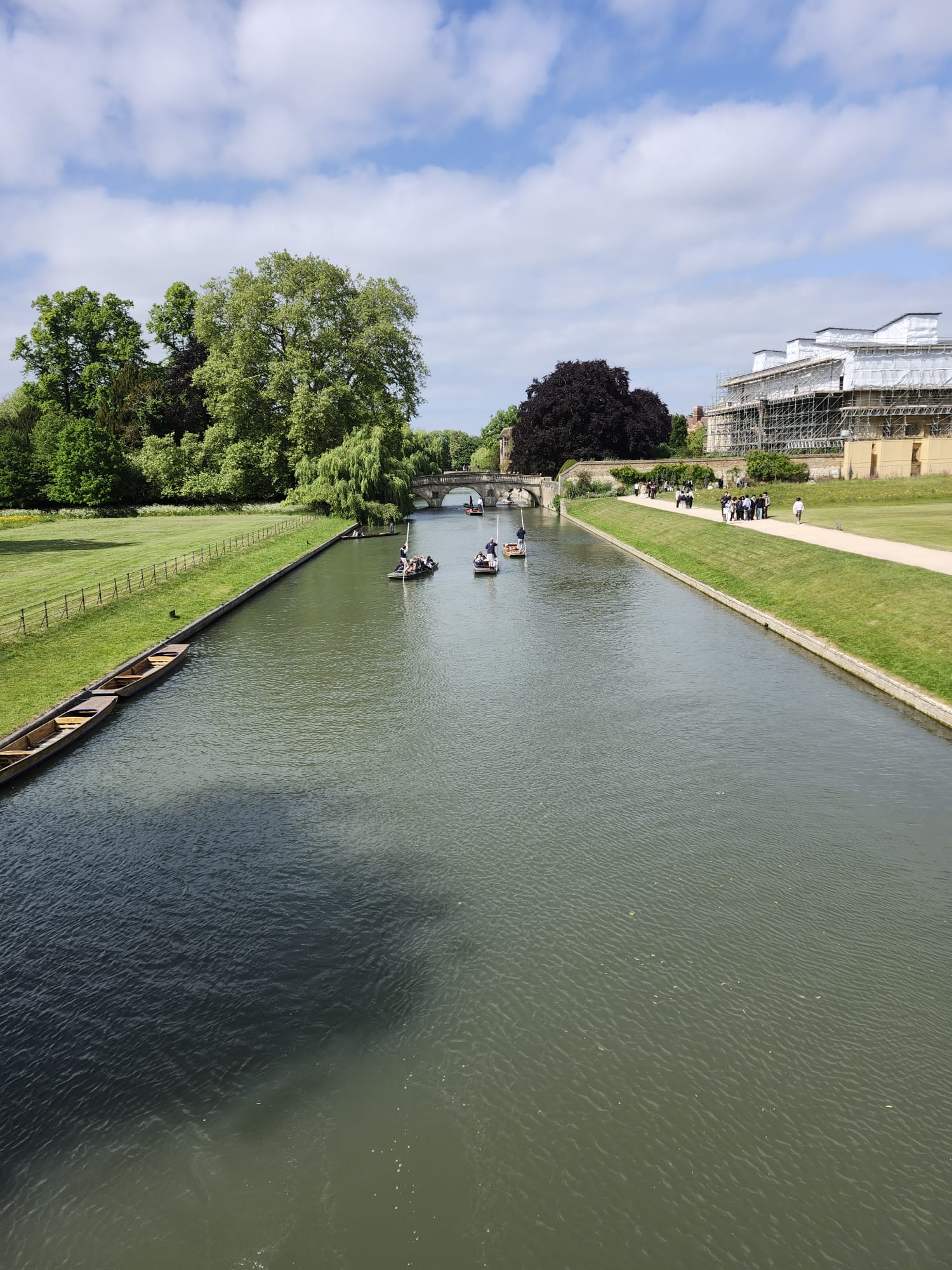
I got into cycling at Cambridge, not as a hobby but because it was how you got anywhere. I would ride from near Jesus towards the faculty where my Development Studies lectures, seminars and supervisions took place, and depending on the route I might go through or around places like King's and Clare, glancing into college gardens on the way.
My accommodation was very close to Jesus and to Sidney Sussex. I had a friend at Sidney Sussex whom I had known from school, and we would have dinner together sometimes. Something that would be a tourist destination almost anywhere else can become part of an ordinary Tuesday.
The knee injury, and what pastoral support actually means
Towards the end of my master's year I injured my knee badly enough that I later needed an operation. For a period I was on crutches, hobbling around Cambridge and unable to cycle anywhere.
Jesus helped me arrange physiotherapy, and the college offered to fund taxis if I needed them to get to teaching. I never actually took them up on the taxis, but I remember being genuinely grateful that the offer existed. That is the moment college pastoral support stopped being an abstract line in a prospectus for me. It was not a welfare policy; it was somebody helping when something had gone wrong.
History becoming real
I remember seeing Stephen Hawking in Cambridge and having that slightly surreal reaction of thinking, I am actually in the same space as Stephen Hawking. No conversation, no encounter, just the fact of it.
The same feeling attaches to the material you study. I was reading economics and development, and John Maynard Keynes is the obvious Cambridge example. I also worked on Singaporean development and later travelled to Singapore, and knowing that Lee Kuan Yew had studied at Cambridge created another line between what I was reading and the city I was reading it in. Ideas have geography. That is not a list of famous alumni; it is the sense that the arguments in your reading list were partly formed a few streets away.
Libraries everywhere
Cambridge gives you several layers of library: the University Library, your faculty or department library, and your college library.
Here is the small detail nobody tells applicants. I happened to be the only MPhil Development Studies student at Jesus College in my year, which meant that, rather unusually, I often had my pick of the Development Studies books in the college library. I still used the University Library and the faculty library, but a lot of the time I did not have to travel anywhere at all.
That is exactly the sort of thing you cannot see from an application form, and exactly the sort of thing that shapes how your week actually works.
People who genuinely love their subjects
What I found consistently was that people cared. If somebody studied English, they cared about English. Historians wanted to argue about history. Economists wanted to argue with me about economics, usually at dinner and usually at length. PhD students had spent years on questions I had barely encountered, and were often delighted to explain them to somebody who asked.
One of my own supervisions was occasionally rearranged because the academic teaching me was going away to campaign: his brother was running for president of Peru. I still find that faintly ridiculous to write down, which is precisely why I remember it.
The freedom to explore
I remember waking up excited about what I was studying, which is not something I say lightly.
Looking back, the thing I value most is not any particular seminar. It is having had the time to go deeply into a subject. Professional life is different. Research has to produce a client answer, a recommendation, a deliverable, some defined output. At Cambridge a question could be worth pursuing simply because it was interesting.
It is one of the relatively few moments in my adult life when I have been given that much permission to go deeply into a subject simply because I wanted to understand it.
Career signalling, honestly
There is also a less romantic point. The Cambridge name carries weight.
I went into consulting afterwards. One of the firms I joined had a very visible concentration of Oxford and Cambridge graduates, including people from my own MPhil programme. My recollection is that virtually everybody in my cohort who was eligible seemed to be applying, and that I was the only person from my particular programme that year who ultimately went there. That is recollection, not data.
Cambridge does not guarantee anybody a job, and it would be dishonest to suggest otherwise. It would be equally dishonest to pretend the name carries no signalling value at all.
What it actually felt like
Cambridge, for me, was getting on a bicycle to go to lectures. Having dinner with people studying completely different things. Being able to use three different libraries. Telling an academic about my ambitions over dinner. Meeting PhD students who had spent years on one question. Seeing Stephen Hawking in the city. Walking through buildings that are centuries old. Hobbling around on crutches and discovering that my college would help. Having the freedom to read and argue properly.
If you are applying, look past the prestige. Look at accommodation, location, financial support, the balance of undergraduates and postgraduates, library access, facilities, community and pastoral provision. If you want to understand how the academic culture that produces all of this selects its students, I have written separately about what Oxbridge interviewers are actually testing. If you are weighing a postgraduate year abroad instead, I have also written about what it is really like to study abroad as an international Master's student.
These things can seem secondary when you are filling in an application form. Once you actually arrive, they become the texture of everyday life.
This article reflects Deep Biswas’s personal experience and perspective. Experiences vary by course, college, degree level and individual circumstances. My Career Impact is independent and is not affiliated with or endorsed by the University of Cambridge.
About the author
Deep Biswas is the founder of My Career Impact. He holds an MBA with Distinction from Harvard Business School and an MPhil from the University of Cambridge. A former UK Government economist, he provides one-to-one tutoring, university admissions coaching and consulting interview preparation.
More about Deep BiswasRelated insights
- What Oxbridge Interviewers Are Really Testing
Subject curiosity, visible reasoning, unfamiliar material and teachability: what Oxford and Cambridge interviews are designed to observe, and why preparation should build intellectual muscle memory rather than scripts.
- How the Harvard Business School Case Method Actually Works
A first-hand account of the HBS classroom: seating, preparation, cold calls, timing a contribution and what the method does and does not teach.