Consulting Interviews
HBS Cases vs Consulting Case Interviews: What Is the Difference?
One is a method of learning, the other compresses months of consulting work into minutes. What actually differs in purpose, structure, assumptions and the final recommendation.
Deep Biswas · Published 6 August 2026 · Updated 7 August 2026 · 9 min read
On this page
- They may both be called cases, but they are doing different things
- A consulting case compresses months of work into minutes
- There is no single answer, but there are clearly better and worse performances
- The recommendation matters more than candidates think
- HBS has a different kind of freedom
- Consulting creates a common toolkit
- One is a classroom, the other is a relationship
- Practice compounds, in both directions
- The case is not the whole hiring decision
- Pedagogy versus selection
- A working comparison
- What transfers from the classroom
- What should not transfer
- What I watch for now
Both involve an ambiguous business problem, a limited amount of information and somebody expected to say something intelligent about it. That similarity is misleading, and candidates who prepare as though the two exercises are the same tend to prepare in the wrong direction.
I studied through the Case Method at Harvard Business School, sat in a section full of former and future consultants, went through consulting case interviews myself, worked in consulting afterwards, and was selected by the HBS Careers Service to coach first year MBA students preparing for consulting interviews. What follows is the difference as I have experienced it from both sides.
They may both be called cases, but they are doing different things
The cleanest way to put it is this. An HBS case is primarily a method of learning. A consulting case interview is primarily a simulation and a selection exercise.
HBS is asking: what can a room full of people learn by debating this managerial decision?
A consulting firm is asking: can this candidate demonstrate some of the behaviours we would expect to see on an actual engagement?
Everything else follows from that difference in purpose. I describe the classroom side in more detail in how the Harvard Business School Case Method actually works.
A consulting case compresses months of work into minutes
This is the thing I understood properly only after working in consulting.
A real engagement might run for weeks or months. Over that time a team has to understand what the client's problem actually is, structure it, define workstreams, form hypotheses, gather information, analyse data, test assumptions, work out which assumptions matter most, react when the evidence moves, synthesise, and recommend something a client can act on.
The case interview takes that entire arc and compresses it into a very short conversation. In some ways it is a simulation of a whole consulting career as much as a single project. An analyst or associate executes the analysis within a workstream. A project manager structures the problem and runs the engagement. A partner originates the work, manages senior client relationships and communicates the recommendation. Having now done most of those things at different points, I read a candidate's performance differently from how I read it when I was preparing for my own interviews. When somebody rushes past the problem definition, I am not thinking about the framework; I am thinking about the client meeting where that omission becomes expensive.
There is no single answer, but there are clearly better and worse performances
Two claims are commonly made about case interviews, and both are wrong.
The first is that every case has a secret correct answer you must find. It does not.
The second is that because there is no single answer, anything goes. That is equally untrue.
Firms are looking at how you structure the problem, what you prioritise, what assumptions you make, whether you justify them, how sensitive your answer is to those assumptions, the accuracy of your quantitative work, how you interpret what the numbers mean, your commercial judgement, your synthesis and your final recommendation.
The assumptions point is where I see the biggest difference between candidates. Making an assumption is easy. What is harder, and much more valuable, is having the foresight to ask which assumptions the answer is most sensitive to. What happens if this one is wrong? Would the recommendation change? What evidence would you want before advising a real client to spend money on this? That is a great deal closer to what consulting judgement actually looks like.
The recommendation matters more than candidates think
The final recommendation is not a summary. It closely resembles the communication consultants have to perform later in their careers.
You should be able to say what the client should do, why, which evidence matters most, what uncertainty remains, which risks are material, and what should happen next. Not everything you calculated. The part that changes the decision.
As you progress in consulting, you spend increasing amounts of your time doing exactly this with senior clients and in sales conversations. The interview is testing an early version of it.
HBS has a different kind of freedom
In the HBS classroom you are placed in the position of a protagonist facing a decision, and then the room argues about what that person or company should do. Structured thinking exists, but it is not policed in the same way. There is far more room to challenge the premise of the case altogether, or to offer what I would loosely call a hot take, and to have that turn out to be the most useful contribution of the class.
Part of the educational value is that people bring genuinely different worldviews. Somebody who has worked in government reads a regulatory case differently from somebody out of private equity. An entrepreneur notices things a banker does not. A classmate from India may read a market entry question quite differently from a classmate from the United States. The divergence is the point.
Consulting creates a common toolkit
HBS also gave me an unusual amount of exposure to how consultants think. In my section it felt like a third or more of the class had either worked in consulting before the MBA or would go into it afterwards, a lot of them from McKinsey, BCG and Bain. That is my impression of my own section rather than any official figure.
What I took from that is how recognisable the toolkit is. Across McKinsey, BCG, Bain, L.E.K., Strategy&, Monitor Deloitte, Dalberg and others, the cultures are different, the clients are different and the internal language varies. But people structure, prioritise, hypothesise, analyse, synthesise and recommend in ways that are legible to each other. Consultants are not interchangeable, and anybody who has worked with several firms will tell you the differences are real. It is more that consulting creates a common professional problem solving language, and once you have learned it you can usually tell how somebody from another strategy firm has been trained to think.
One is a classroom, the other is a relationship
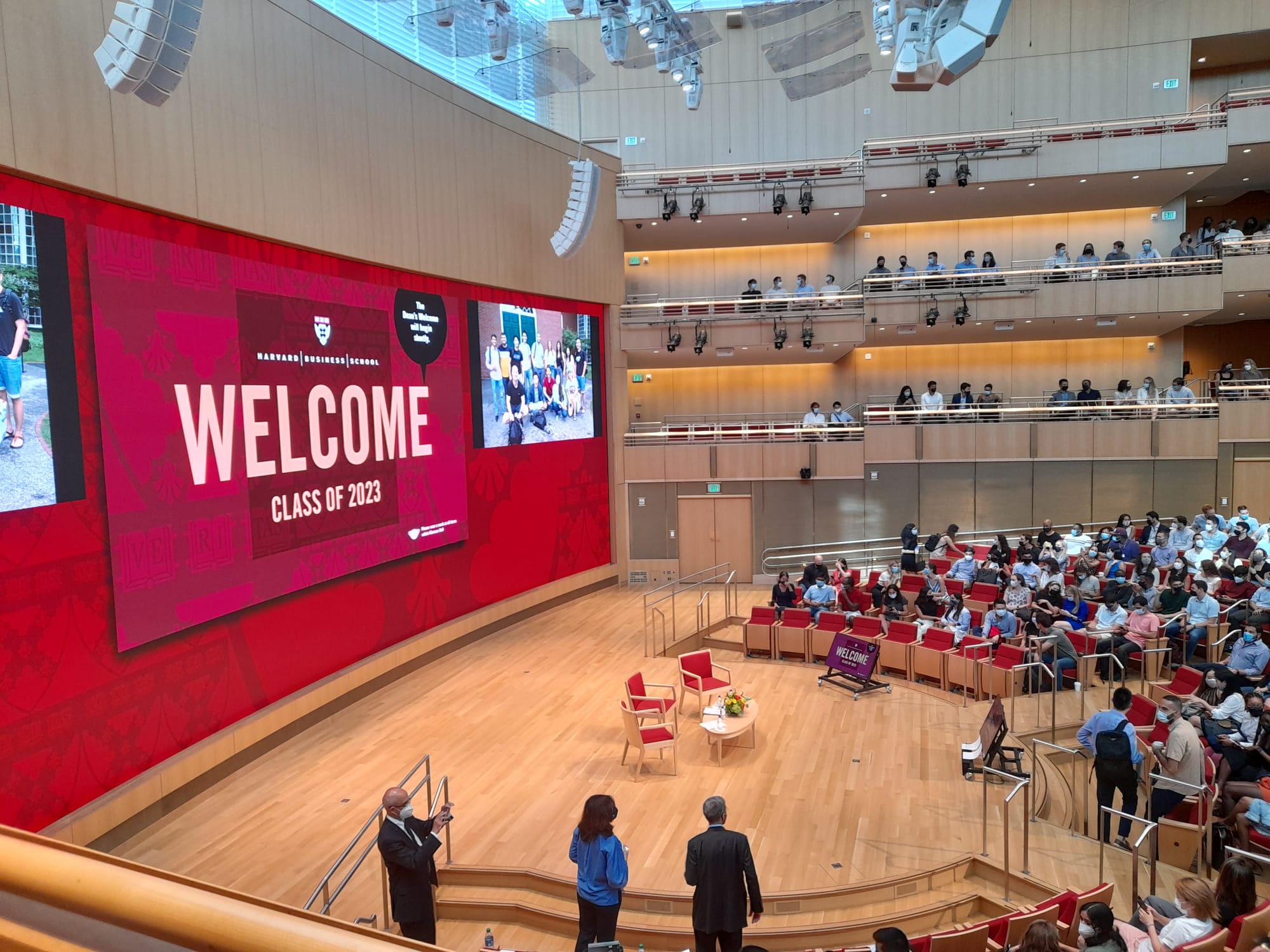
At HBS you are speaking into an auditorium. There is a professor, ninety or so classmates, people building on and demolishing each other's arguments, and a discussion that moves across the room in ways nobody fully controls.
A case interview is much more intimate. One interviewer, one candidate, an hour or less. Even where a firm uses a standardised rubric, you are still building a relationship with a particular person who has their own communication style, their own background and their own way of asking questions. Firms have worked hard to standardise interviews, and they have largely succeeded on the evaluation criteria, but human interaction cannot be made completely identical.
This is one reason why practising exclusively with the same familiar partner is risky. You get very good at being interviewed by one person.
Practice compounds, in both directions
Serious candidates often practise a lot of cases. Ranges like 20 to 40 get quoted frequently in preparation communities. I would not present any number as a proven optimum, because I have not seen evidence that would justify that.
The more important point is that habits compound.
Good habits compound. If you learn early to structure from the specific problem, state your assumptions, narrate your calculations, interpret what a number means and answer the client's actual question, those behaviours become automatic, and automatic behaviour survives pressure.
Bad habits compound too. If your practice partner lets vague structures pass, accepts unjustified assumptions, does not challenge a weak recommendation and nods through arithmetic they have not followed, you are still rehearsing. If the person practising with you repeatedly lets weak structures pass, doing another ten cases may simply make you more fluent in the wrong habits.
The case is not the whole hiring decision
Case performance matters enormously. It is not the entire decision, and candidates often forget this.
Firms may also weigh fit or personal interviews, previous experience, motivation, communication, relevant sector expertise, which office you have applied to, headcount and the wider shape of that year's intake. I am not going to speculate about anything beyond what firms describe publicly.
The underlying point is simple: the firm is hiring a person, not a case score. Two candidates can have what looks like a similar case experience and receive different outcomes for reasons that have nothing to do with the case.
Pedagogy versus selection
Reduced to one line: the HBS case is pedagogical, the consulting case is selective.
The classroom case exists to improve your judgement by exposing your thinking to other people's thinking. Being wrong in public is part of the mechanism. The interview case exists so that a firm can decide whether to keep considering you for a job, and that changes which behaviours are rewarded.
At HBS an interesting tangent can produce a genuinely valuable discussion. In an interview, an interesting tangent that does not help answer the client's question is consuming time you do not have.
A working comparison
| Dimension | HBS classroom case | Consulting case interview |
|---|---|---|
| Purpose | Learning and judgement | Selection |
| Your role | One voice in a debate | The person being assessed |
| Audience | Professor and full section | A single interviewer |
| Information | Provided in advance, in full | Released progressively on request |
| Time | Around 80 minutes | A compressed conversation |
| Structure | Loose, emergent | Explicit and prioritised |
| Diversity of approaches | Actively valuable | Valuable only if it serves the answer |
| Quantitative work | Interpreting prepared exhibits | Live calculation, narrated |
| Recommendation | Optional, collective | Required, individual |
| Assessment | Across a whole course | In a single sitting |
Formats vary by firm, course and interviewer, so read this as orientation rather than rule.
What transfers from the classroom
The Case Method does develop things that help in interviews: comfort with ambiguity, listening properly, building an argument, exercising judgement without complete information, changing your mind when someone makes a better point, responding to disagreement without becoming defensive, and sensing whether what you are about to say actually adds anything. I have written about how that last skill is assessed in how HBS grades class participation.
Consulting forces the same qualities into a tighter discipline. What do you think? Why? What does the evidence tell us? What should the client do next?
What should not transfer
Talking for five minutes to demonstrate breadth. Following an interesting tangent that does not serve the question. Assuming that because several answers are defensible there is no difference between strong and weak reasoning. Confusing creativity with a lack of structure. All of these can work in a classroom. None of them work in an interview.
What I watch for now
Having gone through the classroom, the recruiting process, the job itself, and then coaching first year MBAs through their own preparation, the thing I pay most attention to is not whether somebody reaches the right number.
Two candidates can arrive at exactly the same figure and display completely different levels of judgement. One has calculated. The other knows why the calculation matters, has said out loud which assumption the answer hangs on, has thought about what would change if that assumption is wrong, and has connected the number to the decision the client is actually trying to make.
The number is the easy part to teach. The judgement around it is what the interview is really looking at.
This article reflects Deep Biswas’s personal experience and professional perspective. My Career Impact is independent and is not affiliated with or endorsed by Harvard University, Harvard Business School or any consulting firm.
About the author
Deep Biswas is the founder of My Career Impact. He holds an MBA with Distinction from Harvard Business School and an MPhil from the University of Cambridge. A former UK Government economist, he provides one-to-one tutoring, university admissions coaching and consulting interview preparation.
More about Deep BiswasRelated insights
- How the Harvard Business School Case Method Actually Works
A first-hand account of the HBS classroom: seating, preparation, cold calls, timing a contribution and what the method does and does not teach.
- How Harvard Business School Grades Class Participation and Brings Cases to Life
Relative grading, what a 2 really means, how participation is documented, and what happens when the case protagonist visits the classroom.